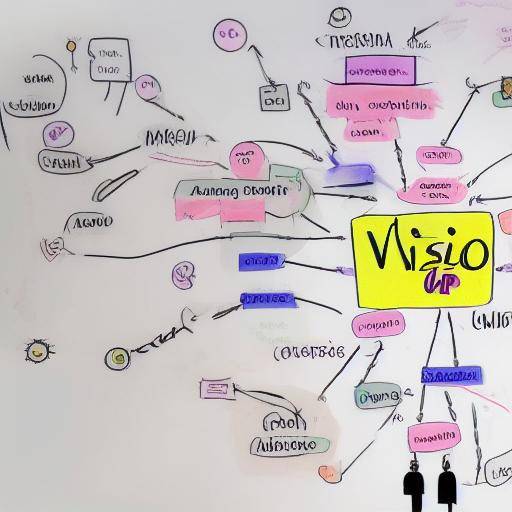
The mind mapping, also known as a mental map, is a powerful organizational and planning technique that can help you establish long-term goals effectively and visually. In this article, we will explore what mind mapping is like, how it relates to long-term goal planning and how you can use this technique to achieve your goals more clearly and efficiently.
Introduction
Imagine having the ability to visualize each of your long-term objectives in a clear and organized way, with the possibility of disaggregating them into concrete and achievable actions. The mind mapping gives you this possibility by allowing you to translate your ideas, thoughts and goals in a non-linear way, fostering creativity, mental clarity and planning efficiency.
In this article, we will explore the origin of mind mapping, its relationship with long-term goal planning, its benefits for productivity and decision-making, as well as practical advice to implement this technique in your daily life. In addition, we will examine various applications of mind mapping and offer a view of experts in the field to enrich your understanding and maximize the impact on achieving your long-term goals.
History and Background
The mind mapping, as a formal technique of visual representation of ideas, was popularized by author and consultant Tony Buzan in the 1970s. Buzan developed the concept of mental maps as a way of organizing nonlinear thinking and fostering the association of ideas in a holistic way.
The mind mapping technique is based on the idea that our brain naturally associates ideas with images and concepts, and the use of mental maps capitalizes this innate process to facilitate understanding and retention of information. Since then, the mind mapping has evolved with the advancement of technology, providing users with endless digital tools to create and share mental maps efficiently.
Analysis in Deep
The mind mapping has proven to be an invaluable tool in various fields, from education to business management. By visualizing complex concepts, identifying relationships and mapping non-linear ideas, mind mapping enhances creativity, problem solving and informed decision-making.
In the area of long-term goal planning, the mind mapping provides a structured way of disaggregating objectives into specific tasks, establishing connections between different aspects of personal and professional life, and visualizing progress in a clear and motivating manner.
Comprehensive review
By applying the mind mapping technique to long-term goal planning, it is crucial to understand your practical applications and concrete benefits. Mental maps facilitate the identification of steps necessary to achieve a goal, help prioritize tasks, and allow for more effective time and resources management.
In addition, mind mapping favors the identification of potential obstacles, the development of mitigation strategies and the visualization of possible alternative routes to achieve long-term goals. This adaptive capacity and flexibility is fundamental in long-term planning, where circumstances can change significantly over time.
Comparative analysis
It is important to distinguish the relationship between mind mapping, long-term goal planning and overall planning. While mind mapping focuses on visual and organized representation of ideas and concepts, long-term goal planning involves defining specific objectives to be achieved on an extended time horizon. For its part, overall planning covers all relevant aspects of personal and professional life, integrating long-term goals into a broader framework of organization and management.
Practical Tips and Accessible Tips
To implement mind mapping in long-term goal planning, follow these practical tips:
- Start clearly identifying your long-term goals and defining the key elements that make them.
- Use colors, images and keywords on your mental map to make it more visual and memorable.
- Disaggregate your goals in smaller and manageable steps, creating additional branches on your mind map to represent every action needed.
- Check and update your mental map regularly as you progress towards your goals, making adjustments as needed.
Industry Perspectives and Expert Reviews
We have consulted various experts in productivity and strategic planning, who share their vision of integrating mind mapping into long-term goal planning.
"The mind mapping is an indispensable tool in project management and the definition of long-term objectives. Its ability to visually represent the structure and interrelationships between different elements is key to effective planning and successful implementation," says Luisa Morales, a business management consultant.
Case Studies and Practical Applications
We will analyze three success stories that illustrate how mind mapping has contributed to the planning and achievement of long-term goals in different contexts:
Case 1: Professional progress
Marta, an entrepreneur in the field of graphic design, used a mental map to visualize her long-term goals related to expanding her client portfolio and launching her own product line. By disaggregating your goals into specific tasks and setting deadlines, you achieved significant growth in your business in just one year.
Case 2: Personal development
Juan, a university student, used mind mapping to plan his educational and professional career. By visually representing her academic, extracurricular and professional goals, she managed to keep her focus on her long-term goals, leading her to obtain a scholarship to study abroad.
Case 3: Financial Management
Maria, a professional in the financial sector, used the mind mapping to trace her long-term financial plan, including savings, investments and asset acquisition goals. This visual approach allowed him to identify growth opportunities and optimize his investment strategy, achieving his goal of financial freedom in less time than anticipated.
Future Trends and Predictions
As long-term planning culture gains relevance in the personal and business environment, the use of mind mapping is expected to continue to expand and diversify. The integration of digital and collaborative tools in the development of mental maps promises to further facilitate their adoption and practical utility in achieving long-term goals.
Conclusions and FAQs
Conclusions
The mind mapping provides a powerful tool to establish and achieve long-term goals by allowing clear visualization, structured planning and effective adaptation to changes. By using this technique in a conscious and creative way, you can enhance your ability to realize your most ambitious aspirations.
Frequently asked questions
1. Is mind mapping only useful for professional goals?
No, mind mapping is equally effective in planning personal, academic, professional and financial goals. Its flexibility makes it applicable to multiple contexts.
2. What tools can I use to create my mental maps?
There are several digital tools, such as MindMeister, XMind and MindManager, which offer a wide range of features to create and share mental maps.
3. Is it possible to make adjustments to a mental map as my long-term goals evolve?
Yes, mental maps are highly adaptable. You can add, modify or delete elements according to your progress and changes in your long-term goals.
4. How can I share my mental map with other collaborators or family members?
Mind mapping tools often offer options to share and collaborate in real time, allowing you to involve other people in planning and achieving your long-term goals.
5. Are there limits on the amount of information that can be included in a mental map?
In theory, there are no limits, but it is advisable to keep mental maps concise and focused to facilitate their understanding and practical utility.
6. What is the relationship between mind mapping and time management in long-term planning?
The mind mapping facilitates the identification of priority activities, the efficient allocation of resources and the effective management of time, which significantly enhances the ability to carry out long-term goals in a systematic and organized manner.
Final conclusion
The mind mapping is a valuable tool for planning long-term goals by providing a visual and structured way to design and materialize your personal and professional goals. By integrating this technique into your planning arsenal, you will be equipped to address your goals with clarity, focus and determination.
In short, the mind mapping not only allows you to visualize your long-term goals, but also provides the tools to disaggregate them into concrete actions, adapt to changes and achieve success with confidence and organization.
Remember that practice and continuous adaptation are key to maximizing the benefits of mind mapping in long-term goal planning.
Take a closer look at the power of mind mapping and discover how this powerful technique can transform your focus towards achieving long-term goals in all aspects of your life!