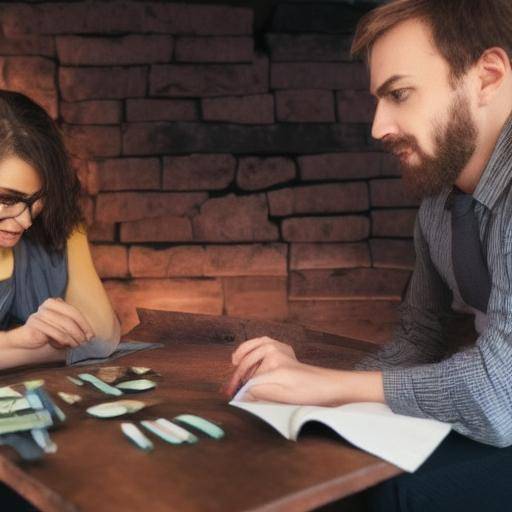
Role-playing is a powerful tool that can be used to improve interpersonal empathy and skills. This technique, which implies taking the role of another person in a simulated situation, can be an invaluable tool to develop a deeper understanding of the emotions, perspectives and experiences of others.
In this article, we will explore in detail how role-playing can be used as an effective strategy to strengthen empathy, addressing its history, benefits, practical applications, and offering guidance for implementation. In addition, we will examine your relationship with interpersonal skills and explore future trends in this field.
Introduction
Role-playing is a technique that has been used for decades in a variety of contexts, from psychological therapy to entrepreneurship. By assuming the role of another person, whether in a realistic or imaginary scenario, people can acquire a deeper understanding of the emotions, motivations, and thoughts of others.
In an increasingly interconnected world, where empathy and interpersonal skills are fundamental to personal and professional success, role-playing has become a valuable tool for developing these skills. Throughout this article, we will explore how role-playing can be effectively used to improve interpersonal empathy and skills, providing practical advice and concrete examples of its application.
History and Background
The role-playing has its roots in theatre and psychotherapy. Throughout history, it has been used in different cultures and contexts for the purpose of exploring and understanding human experience from diverse perspectives. In psychotherapy, role-playing has been a fundamental tool to help patients explore and understand their own emotions, as well as those of others.
The use of role-playing has expanded to fields such as entrepreneurship, education, and personal development. As understanding the importance of empathy and interpersonal skills has grown, role-playing has gained prominence as an effective strategy to foster understanding and empathy towards others.
Analysis in Deep
The role-playing offers a number of significant benefits for those seeking to improve their interpersonal empathy and abilities. By assuming the role of another person, participants can develop a deeper understanding of the emotions, motivations, and perspectives of others. This can lead to greater empathy and sensitivity towards the experiences and challenges facing others.
However, role-playing is not without challenges. Some people may feel uncomfortable or unsafe assuming roles that differ from their own identity. In addition, the effectiveness of the role-playing depends to a large extent on the quality of the simulation and the ability of the participants to suspend their unbelief and fully commit to the exercise. Despite these challenges, role-playing remains a valuable tool for the development of empathy and interpersonal skills.
Comprehensive review
There are numerous practical role-playing applications to improve interpersonal empathy and skills. For example, in working environments, role-playing can be used to simulate difficult or conflicting situations, allowing participants to practice empathy and conflict resolution in a safe and controlled manner.
In addition, role-playing can be used in educational environments to help students develop a deeper understanding of others' experiences and perspectives. By simulating real life situations, students can acquire a deeper understanding of the emotions and challenges facing people in different contexts.
Comparative analysis
Role-playing and empathy are intrinsically related, as role-playing can be an effective vehicle to develop empathy towards others. By assuming the role of another person, one can experience and understand the emotions, thoughts and perspectives of that person, which in turn can lead to greater understanding and empathy.
On the other hand, interpersonal skills are also reinforced through role-playing. By practicing communication, active listening and conflict resolution in a simulated environment, participants can develop critical skills that are essential to successful interactions in real life.
Practical Tips and Accessible Tips
If you are interested in incorporating role-playing to improve interpersonal empathy and skills, here are some practical tips that can help you start:
- Select realistic scenarios that reflect everyday situations where interpersonal empathy and skills are needed, such as conflict resolution or stress situations.
- Attend roles and characters to participants, making sure they represent a variety of perspectives and experiences.
- It provides sufficient time for participants to assume their roles and immerse themselves in simulation.
- It facilitates deep reflection after each role-playing session, encouraging participants to share their experiences, perspectives and learnings.
- It offers constructive feedback and opportunities to practice and perfect the skills acquired through role-playing.
Industry Visions and Expert Reviews
Experts in psychology, interpersonal development and organizational leadership have recognized the value of role-playing as an effective strategy to improve interpersonal empathy and skills. Many have emphasized the ability of role-playing to foster a deeper understanding of the emotions and perspectives of others, which in turn can strengthen interpersonal relationships and conflict resolution.
In addition, experts have recommended role-playing as a valuable tool for fostering inclusion and diversity in educational and labour environments, promoting a deeper understanding of the experiences and challenges facing people from diverse backgrounds and cultures.
Case Studies and Real Life Applications
Numerous case studies have demonstrated the positive impact of role-playing on the development of empathy and interpersonal skills. For example, in educational settings, role-playing has been used to promote understanding and empathy towards school harassment experiences, fostering a safer and more compassionate school environment.
In the workplace, role-playing has been used to improve communication, leadership and conflict management skills, leading to greater collaboration and cohesion in teams and organizations.
Future Trends and Predictions
As the importance of empathy and interpersonal skills continues to be recognized in various fields, role-playing is expected to remain a valuable tool for its development. With the advancement of technology, we are likely to see a greater integration of virtual simulations and increased reality in role-playing, offering more immersive and realistic experiences.
In addition, the role-playing is expected to be applied more broadly in areas such as medical care, social justice and organizational leadership, providing opportunities to foster a deeper and more empathic understanding of the experiences and challenges of others.
Conclusions
In short, role-playing can be a valuable tool for improving interpersonal empathy and skills. By assuming the role of another person in simulated situations, participants can develop a deeper understanding of the emotions, thoughts and perspectives of others, which in turn can foster empathy and strengthen interpersonal skills.
By incorporating role-playing in educational, labour and therapeutic environments, we can cultivate a more comprehensive, inclusive and collaborative society. With the continuous development and innovative application of role-playing, we can expect this technique to continue to play a key role in the development of empathy and interpersonal skills in the future.
Frequently asked questions
What is role-playing and how does it relate to empathy?
Role-playing is a technique in which participants assume fictitious or real roles to represent realistic situations. It is related to empathy by allowing participants to experience and understand the emotions, perspectives and experiences of others.
What are the benefits of role-playing for the development of empathy?
Role-playing can strengthen empathy by providing an opportunity to practice understanding the emotions and perspectives of others. This technique allows participants to experience situations from different points of view, thus fostering greater sensitivity and understanding.
What are some common scenarios where you can use role-playing to improve empathy?
Role-playing can be used in conflict resolution situations, emotions management, interpersonal communication, and in the understanding of stress or crisis situations. These scenarios offer opportunities to practice empathy and understanding of the emotions of others.
How can you implement role-playing in educational environments to promote empathy?
In educational settings, role-playing can be used to represent situations of intimidation, discrimination, or exclusion, offering students the opportunity to experience and understand the emotions and perspectives of the people involved.
What is the role of role-playing in the development of interpersonal skills?
Role-playing can play a key role in developing interpersonal skills by allowing participants to practice effective communication, conflict resolution, active listening, and collaboration in a simulated environment.
What are future trends in the use of role-playing to promote interpersonal empathy and skills?
The use of role-playing is expected to expand through the integration of emerging technologies, with more immersive and realistic experiences. In addition, role-playing is expected to be implemented in diverse contexts, including medical care, organizational leadership, and social justice.
Concluding, role-playing is a valuable technique that has the potential to positively impact the development of empathy and interpersonal skills. Its ability to foster a deeper understanding of the emotions and perspectives of others makes it a crucial tool for creating meaningful human connections in various environments.
In a world where empathy and understanding are fundamental to promoting understanding and collaboration, role-playing is built as a powerful tool to promote more connected and compassionate relationships.